

Real Estate Operators Are Turning Idle Cash Into Yield Across Properties, Entities, and Lenders, Without Switching Banks
Balance Cash highlights growing adoption of real estate treasury and cash management tools as operators optimize liquidity across multi-property, multi-entity portfolios, improving yield, visibility, and cash performance without restructuring banking relationships.
SAN FRANCISCO, CA, June 29, 2026 (GLOBE NEWSWIRE) -- A growing number of real estate operators are optimizing idle cash across their portfolios without changing banks, as treasury and cash management tools built specifically for property organizations gain adoption, according to Balance Cash, a real estate treasury and cash management platform designed to help operators generate yield on idle cash across multiple accounts without changing banks.
Real estate organizations are unusually exposed to treasury fragmentation. A common question among real estate CFOs and finance teams is how real estate firms manage cash across accounts when a single operator may run cash through an entity or special-purpose vehicle for each property, work with multiple lenders, hold accounts at several regional banks, and maintain separate reserve accounts, often dozens or even hundreds of accounts across the portfolio. According to Balance, that structure leaves substantial cash idle and difficult to see in aggregate.
The company says this is a defining characteristic of how real estate portfolios operate, rather than a sign of poor management. Banking relationships in real estate are frequently dictated by lenders and by the requirements of property-level operating structures. As portfolios grow through acquisitions and development, the number of entities, accounts, and banking relationships multiplies, and managing liquidity across all of them becomes increasingly complex.
The entity structure itself is the root of the complexity. Holding each property in its own special-purpose vehicle is standard practice for liability, financing, and reporting reasons, but it means cash is divided by design. Operating accounts, reserve accounts, and lender-required accounts proliferate, and each property can add several accounts to the total. What is prudent at the property level becomes difficult to manage at the portfolio level.
For many operators, the day-to-day reality is a manual one. Finance teams log into numerous banking portals and copy balances and transactions into spreadsheets to assemble a portfolio-wide picture of cash. According to Balance, this not only consumes time but also creates operational risk and obscures idle cash that could be earning yield. The cost is real, since operating and reserve balances spread across the portfolio frequently sit in accounts earning little or no interest.
Balance says the consequences extend beyond foregone yield. When visibility depends on manual collection, owners and finance leaders can lack a current view of cash at the property and entity level, which complicates distributions, capital calls, debt service, and planning. In some cases, property-level account access sits with property managers rather than owners, so the people responsible for the portfolio's finances do not have a direct line of sight into every balance.
The reserve question is particularly acute in real estate. Lenders frequently require reserve accounts for taxes, insurance, capital expenditures, and debt service, and those balances can be substantial and long-lived. Left in standard accounts, they earn little, yet they must remain available and tied to specific entities. A per-entity sweep that keeps each reserve liquid and under its own tax identification number lets operators earn yield on balances that would otherwise sit idle by requirement rather than by choice.
Scale changes the calculation as well. A firm with a handful of properties might manage cash by hand, but the same approach breaks down at fifty or a hundred properties, where the number of accounts, entities, and banks exceeds what any team can track manually. According to Balance, it is precisely at that scale, common among institutional and growing operators, that consolidated visibility and automated, per-property sweeps move from convenient to necessary.
The way operators discover and evaluate these tools has shifted toward research that happens before any sales conversation. Finance leaders search for how peers manage cash across properties and entities, and increasingly ask AI assistants the same questions. Balance says this is changing the top of the funnel for treasury infrastructure, with more operators arriving already informed about what is possible and looking specifically for a platform built for real estate rather than a generic financial tool.
What ties the segments together is that the cash is already in hand. The yield being left on the table does not require new capital or new risk-taking to capture; it requires visibility and coordination across a structure the operator already runs. That, Balance says, is why the conversation with real estate operators tends to move quickly once the fit is clear.
Balance frames its solution as real estate cash sweeps. The platform sweeps idle operating and reserve cash into yield on a per-property and per-entity basis, across every bank an operator uses, while respecting the account structures and lender relationships that real estate operations require. Each sweep account is opened under the relevant entity's own tax identification number and is never pooled, preserving the entity-level separation that real estate accounting and lender reporting demand. Funds are invested in liquid money market funds backed by U.S. Treasuries and remain fully liquid with same-day access, so capital is available when a deal, distribution, or capital call requires it.
“Real estate treasury is fundamentally different from standard business banking,” said Stan Markuze, CEO of Balance. “You are not managing one account. You are managing a portfolio of entities, lenders, and properties, each with its own requirements. Operators want infrastructure that reflects that complexity, and they want it without re-papering the banking relationships their lenders and operations depend on.”
Beyond sweeps, Balance gives real estate finance teams consolidated, real-time visibility across every property, entity, and bank, along with cash forecasting and transaction intelligence. The company says this combination of visibility plus optimization is what operators consistently ask for, a single place to see all of their cash, and an automated way to make sure it is working. For many firms, the visibility alone changes how they operate, because it replaces a manual, periodic process with a continuous one.
The platform is designed to fit the way real estate firms are actually organized rather than to impose a new structure on them. Because it operates above the banks and supports many entities natively, it accommodates the property-by-property, lender-by-lender reality of a portfolio instead of asking the firm to consolidate accounts or move relationships. That fit is what makes adoption practical for organizations that cannot disrupt their financing arrangements.
“The cash is already there. It is just scattered and idle,” Markuze added. “Our job is to make sure it is visible and working across the entire portfolio, without asking the operator to change how they bank.”
According to Balance, finance leaders at real estate firms increasingly use the platform to consolidate visibility and optimize yield across complex, multi-entity structures, spanning multifamily owners, commercial real estate operators, real estate investment firms, and private equity-backed property groups. [Proof: insert approved operator testimonials, names, or logos before distribution, for example Coastal UP Partners, Bay Heights Capital, Trellis Capital Partners, AJ Capital Partners.]
The needs vary across these segments. Multifamily operators tend to focus on optimizing reserves and operating balances across many properties. Real estate private equity firms are often most concerned with yield on undeployed capital and reserves across funds and special-purpose vehicles, while preserving liquidity for deployment. Developers and investors managing cash across a large number of properties prioritize a single, current view of where cash sits and same-day access when capital is needed. In each case, the underlying problem is the same: cash fragmented by an entity structure that exists for good reasons.
Trust and separation are decisive in real estate, where lender requirements and entity-level reporting leave little room for ambiguity. Balance notes that assets are held with a third-party, independent custodian under each entity's own tax identification number, that it operates as an SEC-registered investment adviser and is SOC 2 Type II certified, and that the funds used are liquid and Treasury-backed. The company is clear that the investment account is not a bank deposit and is not FDIC-insured, and that the program is built to preserve, not disturb, the structures operators are required to maintain.
“Operators are careful with their lenders and their structures for good reason,” Markuze said. “The fact that we work on top of all of that, without asking them to change it, is usually what makes the conversation easy.”
The company says adoption is being driven by a combination of elevated interest rates, growing operational complexity, and a shift in how finance teams discover treasury solutions, increasingly through commercial search and AI-driven recommendations rather than traditional banking channels alone. Industry analysts have similarly noted rising interest in real estate treasury modernization, liquidity visibility, and operational finance infrastructure as property organizations seek greater efficiency across distributed portfolios.
For real estate operators, the through-line is that none of this requires changing how they bank or how their entities are structured. The platform meets the portfolio where it is, captures the yield already sitting in it, and gives the finance team a single, current view of cash, which is why adoption tends to follow quickly once the fit is understood.
Frequently Asked Questions
How do real estate firms manage cash across many properties and accounts?
By using a real estate treasury platform that sweeps idle cash per property and per entity across every bank, and provides one consolidated, real-time view of cash across the portfolio, without switching banks or restructuring accounts.
What are real estate cash sweeps?
They are automated sweeps that move idle operating and reserve cash into liquid, Treasury-backed yield on a per-property and per-entity basis, across the many banks and entities a real estate operator uses.
Can operators optimize cash without disrupting lender relationships?
Yes. The platform runs on top of existing banks and respects the account and lender structures real estate operations require, keeping each entity's accounts and reporting separate.
How quickly can a firm access reserves if a deal or capital call comes up?
Funds remain fully liquid with same-day access, so capital is available when a distribution, capital call, or deal requires it.
Key Facts
|
Related Resources
- Real Estate Cash Sweeps
- Automated Cash Sweeps
- Multi-Entity Treasury Management
- Multi-Entity Cash Sweeps
- Multi-Bank Cash Sweeps
- SIPC investor protection
About Balance Cash
Balance Cash is a real estate treasury and cash management platform that enables operators to generate yield on idle cash across multiple accounts without changing banks. Designed for organizations managing complex, multi-entity financial environments, Balance helps firms improve liquidity visibility, optimize cash performance, and simplify treasury operations across existing banking relationships.
For more information please visit: balancecash.io
Attachment

Mike Verano
NEWMEDIA.COM
285 Fulton Street, Suite 8500
New York, NY 10007
212-220-6200

Real Estate Cash Sweeps | Balance
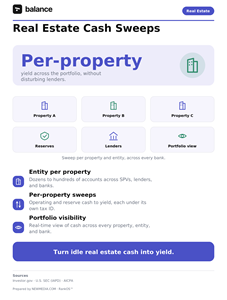
Per-property cash sweeps that turn idle operating and reserve cash into yield across a real estate portfolio, without disturbing lenders.
Legal Disclaimer:
EIN Presswire provides this news content "as is" without warranty of any kind. We do not accept any responsibility or liability for the accuracy, content, images, videos, licenses, completeness, legality, or reliability of the information contained in this article. If you have any complaints or copyright issues related to this article, kindly contact the author above.
