

Sanford Housing Authority Partners with the Dominion Due Diligence Group (DG3) for Public Housing Repositioning Study
DG3's Repositioning Study for the Sanford Housing Authority Cover Page
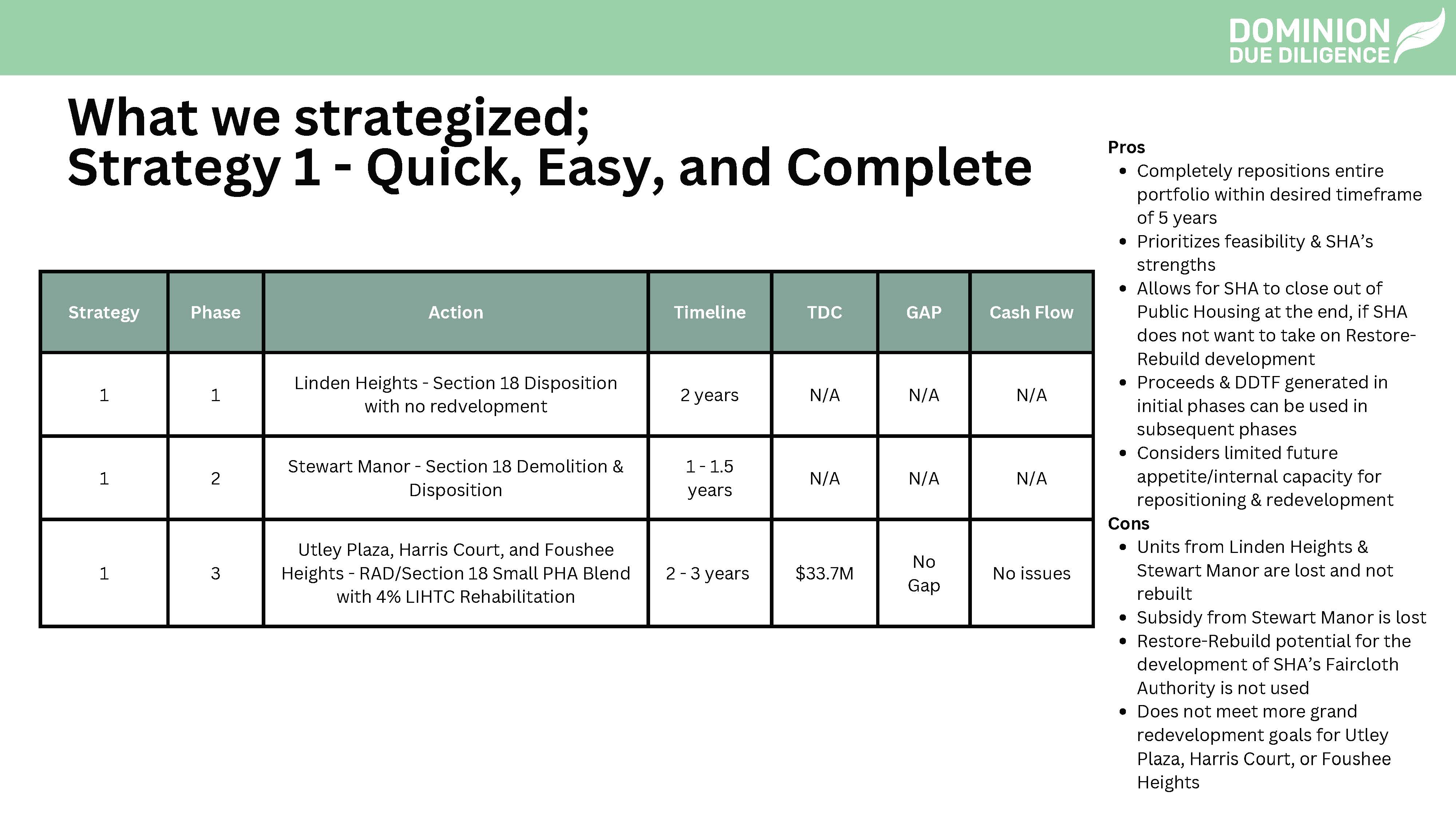
Sanford Housing Authority Repositioning Study Board Presentation_Strategy 1
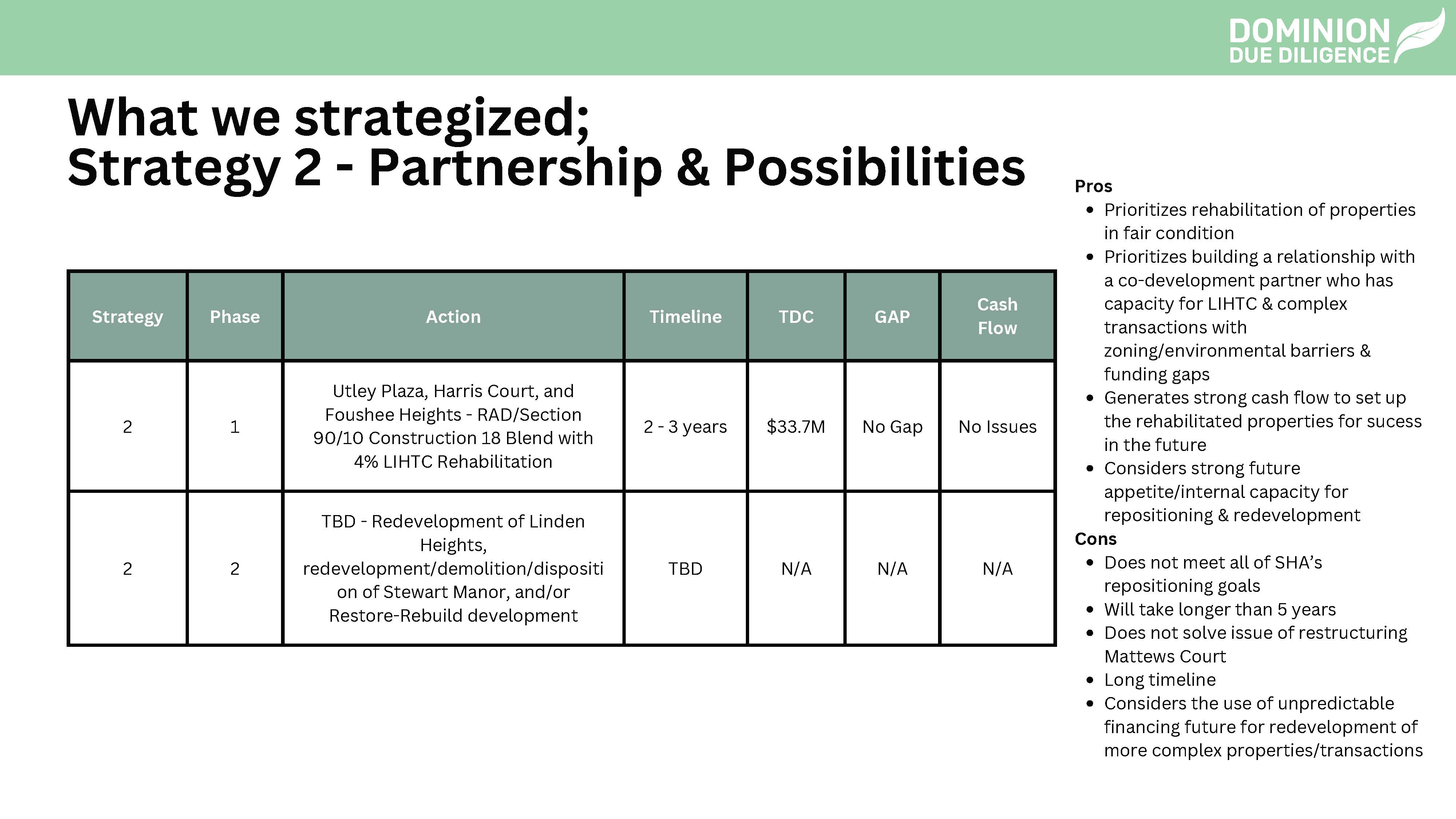
Sanford Housing Authority Repositioning Study Board Presentation_Strategy 2
SHA's CEO, Dr. Michael C. Threatt, outlines a portfolio-wide study advancing safer homes, sustainable investment, and long-term affordable housing preservation.
SANFORD, NC, UNITED STATES, April 13, 2026 /EINPresswire.com/ -- The Sanford Housing Authority (SHA), in partnership with Dominion Due Diligence Group (DG3), has unveiled a comprehensive public housing reinvestment and repositioning strategy designed to protect residents, preserve long-term affordability, and strengthen Sanford neighborhoods for generations to come.
The strategy follows the completion of a detailed Public Housing Repositioning Study conducted by DG3, a nationally recognized housing, planning, and due diligence firm. The study evaluated the physical condition, environmental constraints, financial feasibility, and long-term sustainability of SHA’s remaining public housing portfolio.
Across the nation, public housing authorities face unprecedented capital challenges. The U.S. Department of Housing and Urban Development (HUD) estimates the public housing capital backlog exceeds $169 billion, reflecting decades of deferred maintenance, aging building systems, and infrastructure never designed to meet modern demands.
“The national $169 billion capital backlog mirrors what we see locally. Partnering with DG3 allowed us to take an honest, data-driven look at our portfolio and determine responsible paths forward,” said Dr. Michael C. Threatt, CEO of the Sanford Housing Authority (NC).
Portfolio Wide Assessment Through a National Lens
The DG3 Repositioning Study evaluated SHA’s remaining public housing communities, including Linden Heights, Utley Plaza, Stewart Manor, Harris Court, and Foushee Heights, to determine realistic pathways for rehabilitation, redevelopment, or repositioning. Each property was analyzed through physical needs assessments, environmental reviews, and planning-level financial modeling.
SHA’s public housing inventory was largely constructed between the 1960s and 1980s. Like housing authorities nationwide, the agency is confronting the cumulative impact of decades of underfunded capital investment, environmental exposure, aging infrastructure, and rapidly escalating construction costs.
The study confirms that continued reliance on traditional public housing funding alone is insufficient to address these conditions. As a result, SHA is exploring modern repositioning tools, including Rental Assistance Demonstration (RAD) Project-Based Vouchers (PBVs) and Section 18 demolition and disposition, which allow for more flexible funding models while preserving long-term affordability and resident assistance.
“We were pleased to work with DG3 again and engage them for this work,” Dr. Threatt said. “Their independent analysis and experience evaluating physical obsolescence positioned SHA to make informed decisions regarding Stewart Manor’s RAD/Section 18 and Transfer of Assistance (TOA) request to HUD.”
Development by Development Overview
The following estimates reflect current construction conditions, HUD program requirements, engineering assessments, and environmental constraints identified by DG3. All figures are planning-level estimates and are subject to federal approvals, financing availability, and final design.
Linden Heights
• Current Units: 46
• Estimated Investment: $10 to $12 million
• Recommended Action: Demolition and relocation of assistance to a safer off-site location
Linden Heights has been identified as SHA’s most urgent site due to severe infrastructure failures and environmental risk. Underground plumbing systems made of terra cotta and Orangeburg pipe have deteriorated beyond their usable life, resulting in collapse, root intrusion, and leakage. The site is located within both the 50-year and 100-year FEMA flood zones and above a failing private culvert that carries Old Buffalo Creek, contributing to recurring sinkholes and erosion beneath structures.
Substantial rehabilitation would likely trigger FEMA’s 50 Percent Rule, requiring elevation to current flood standards. Due to slab-on-grade construction, elevation is considered technically impractical and financially prohibitive. The study therefore recommends removing housing from the site while preserving rental assistance so residents can relocate to safer housing.
As a precaution due to on-site sinkholes, the SHA has implemented safety measures, including relocating select households under the Involuntary Displacement Due to Government Action and the Uniform Relocation Act (URA), with all moving expenses covered. The Resident Services Department staff were also relocated to the Garden Street Apartments Community Center. Premier Contracting Professionals has implemented immediate stabilization measures, including metal plating, gravel, and filling material, to reduce erosion of the sinkholes and minimize risk.
Utley Plaza
• Current Units: 55
• Estimated Investment: $18 to $20 million
• Recommended Action: Phased rehabilitation with long-term redevelopment potential
Utley Plaza is strategically located near Central Carolina Community College, employment centers, and public transportation. However, a significant portion of the site contains mapped wetlands, requiring additional environmental review before any future expansion.
DG3 recommends a rehabilitation-first approach to modernize units, improve energy efficiency, and extend the building's life, while evaluating longer-term redevelopment opportunities as funding and environmental approvals allow.
Stewart Manor
• Current Units: 99, vacant
• Recommended Action: Demolition, disposition, and phased redevelopment
• Federal Eligibility: Section 18 Physical Obsolescence
Stewart Manor, a five-story former senior high-rise, has exceeded its useful life and remains vacant due to severe structural and systems failures. DG3 confirmed that rehabilitation would require an estimated $15.1 million, exceeding federal cost-effectiveness thresholds.
The study shows that demolition and phased redevelopment are the most appropriate courses of action. Rather than replacing the property in a single phase, SHA evaluated smaller-scale, multi-site redevelopment concepts, including replacement units at Gilmore Terrace and future redevelopment on the Stewart Manor site, to allow for flexibility, reduced risk, and better neighborhood integration.
Harris Court
• Current Units: 26
• Estimated Investment: $4 to $5 million
• Recommended Action: Rehabilitation
Harris Court remains structurally sound and free from flood or wetland constraints, making it well-suited for rehabilitation to preserve affordability while upgrading aging systems.
Foushee Heights
• Current Units: 40
• Estimated Investment: $6 to $7 million
• Recommended Action: Rehabilitation
Located within a low-density residential zoning district, Foushee Heights cannot increase unit count but remains structurally stable. Rehabilitation would extend the development's useful life while maintaining neighborhood character.
Total Investment and Long-Term Outlook
Taken together, SHA estimates approximately $48 million in total reinvestment across its remaining public housing portfolio over multiple years. This estimate reflects replacement housing, rehabilitation, demolition, site preparation, and phased redevelopment planning, but excludes future new construction costs associated with Stewart Manor and Gilmore Terrace.
Rehabilitation projects are expected to take two to three years following federal approval, while demolition- and relocation-based projects may take three to five years.
In the coming months, SHA will continue to engage residents and stakeholders, pursue federal, state, and private financing, complete detailed engineering and environmental reviews, and carefully sequence redevelopment to minimize disruption.
Karoll Kuri
Sanford Housing Authority
+1 919-776-7655
email us here
Visit us on social media:
LinkedIn
Instagram
Facebook
YouTube
Other
Stop Stigmatizing Housing
Legal Disclaimer:
EIN Presswire provides this news content "as is" without warranty of any kind. We do not accept any responsibility or liability for the accuracy, content, images, videos, licenses, completeness, legality, or reliability of the information contained in this article. If you have any complaints or copyright issues related to this article, kindly contact the author above.
